



An Overview of the Flammability Requirements for Custom Cables By Steven J. Goodman, User Interface & Cable Assembly Product Manager Epec Engineered Technologies
Though electrical fires are broadly defined as “any fire that involves some type of electrical failure or malfunction", the actual events themselves can be much more specific than that, particularly when you consider why they are often caused. According to one recent study, one of the leading direct causes of electrical fires around the country is faulty wiring.
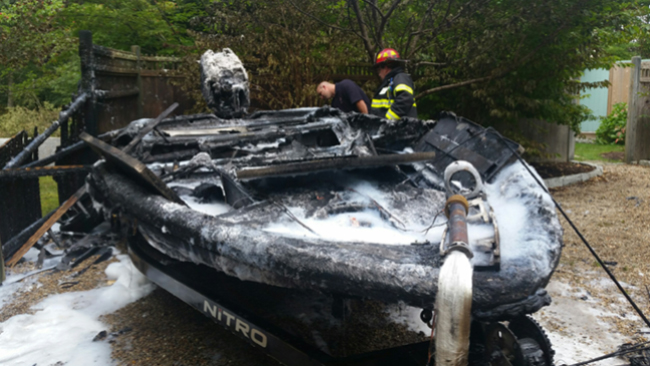 Figure 1: Fishing boat destroyed by an electrical fire.
This is especially true in environments such as a home that is more than 20 years old, as it may not actually have the wiring capacity necessary to safely handle the increased numbers of electrical items that we use more and more in our daily lives. When you consider an environment like a business, which itself can have dozens or even hundreds of computers, office equipment, server and network items, and even HVAC systems, it's easy to see why this problem is such a severe (and unfortunately, common) one.
For the sake of completion, note that the other primary causes of electrical fires include faulty outlets and/or appliances, faulty light fixtures, the improper use of extension cords, and the improper or unsafe placement and usage of space heaters.
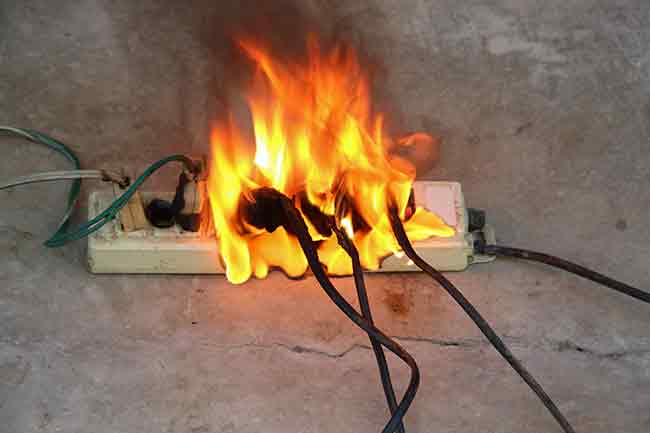 Figure 2: Household outlet electrical fire.
This is why the flammability requirements for custom cables are so important, they're designed to help curb exactly these types of situations as much as possible. Consider the fact that, according to the National Fire Protection Association, there were roughly 45,210 home structure fires that fell into the "electrical fire" category alone. These instances not only led to 420 deaths, but over 1,300 injuries and caused $1.4 billion in direct property damage.
Features like cable jackets aren't just designed to help prevent as many electrical fires as possible, they are also intended to stop the spread of those fires or to provide the ability to self-extinguish. The actual flammability requirements of those cables will vary based on a wide range of different factors that are more than worth exploring.
The Flammability Requirements of Custom Cables: Breaking Them Down
What many people don’t realize about cabling is that the flammability rating requirement is dictated, in part, by both the location of that cable and the way in which it is being used.
As of 2018, some of the existing industry standard flammability ratings for cables includes the following:
- VW-1: These cables have passed a VW-1 flame test and carry a “fire resistant” designation. The VW-1 test provides an assessment of the cable insulation material and resilience to fire. This is one of the most severe tests since it’s performed vertically and can be viewed as a worst-case test condition. However, VW-1 cables are not appropriate for all applications such as those with confined spaces or high airflow. A careful assessment of the use case and installation environment must be made before electing to use a VW-1 rated cable.
- CL2 & CL3: NEC (National Electric Code) has an established standard defined in Article 725 for low voltage applications, less than 150 volts. This rating provides fire resilience and protection from electrical shock. CL2 & CL3 cables are also designed to support specific pull forces and 90-degree bends. Many low power/high frequency cables such as high-resolution video and coaxial cables carry the CL2 and CL3 designation.
- Plenum: These types of cables are designed for installation in areas with forced air ventilation, air handling, and cooling systems. Since the high air flow environment can cause fire to rapidly spread, a cable jacket with fire retardant jacket is critical to prevent fire propagation. Since these cables may be collocated around air handling systems, there is also a need to minimize the amount of smoke produced if the cable jacket does combust. Specialized jacket materials can be employed for low-smoke characteristics. A non-plenum cable should never be used in an area that requires a plenum rating.
Other common types of flammability ratings include OFNR (Optical Fiber Nonconductive Riser), which is given to fiber optic cables that are designed to be used in vertical runs within buildings. OFNP (Optical Fiber Nonconductive Plenum) is the same but is designed for horizontal runs while also exhibits low smoke characteristics, similar to a plenum rating. CM (similar to CL2 and CL3), CMR (similar to CL2 and CL3 but for a riser applications) and CMP (similar to CL2 and CL3 but for a plenum applications) are ratings also given to network cables, they are roughly equivalent to Article 725 cables but are designed for much lower power ratings, such as ethernet cables.
Testing Procedures for Custom Cables
In order to make sure that a particular cable meets the necessary flammability requirements, a wide range of different testing procedures are often used. These procedures are typically performed in either the vertical or horizontal orientation.
Listed below are some examples of burn test procedures with their severity increasing from top to bottom:
- FT2: This test represents the bare minimum horizontal burn test for flexible cables. During this test, a flame is applied to a sample in the horizontal orientation five times for 15 seconds. For the cable specimen to pass, there shall be no burning particles that fall from the cable specimen.
- VW-1: Recognized by both UL and CSA standards, this is a 3,000 BTU/hr vertical flame test and can be performed on both the completed lengths of bulk cable or jacketed single conductors. For reference, a 3,000 BTU/hr burner is approximately the same size as a Bunsen burner. This test includes the use of indicators above and below the specimen. The cable must self-extinguish in a predetermined amount of time and also not ignite the flammable indicators above and below the specimen to be considered compliant.
- UL 1666: Also referred to as the UL-Riser cable test, this 495,000 BTU/hr test is used on cables that are employed in vertical runs that may often span across more than one floor in a particular building. This test is performed in a 12-foot-tall chamber. The cable section will pass this requirement if after 30 minutes of flame exposure the flames do not reach the 12-foot height of the chamber.
Other Considerations
It's also important to note that, depending on the application, there are a wide range of additives that can be added to custom cable jackets in an effort to better improve their fire resistance based on whatever your unique needs may happen to be.
The two main types of additive systems that are commonly used for this purpose are halogenated and non-halogenated, both of which work hard to suppress a flame should one occur. Halogenated systems are generally less expensive which makes them quite popular for large-scale applications, however, non-halogenated systems tend to put out fewer toxins. As always, it's important to match the system with the specific type of cable, the requirements you're trying to meet, and the application for the absolute best results.
Polyphosphonates are another example of an additive that can be used on custom cabling to not only help balance the flame-retardant performance of the jacket and cable itself, but to also help achieve other properties - be they mechanical, cost-related, or both. They are very popular because they can be easily processed into films and fiber materials for cabling uses and can even be injection molded into thinner sections to help meet a specific flammability requirement over a long distance.
The Epec Engineered Technologies Approach
At Epec Engineered Technologies, we're proud of our ability to help clients all over the country customize their cable assemblies to not only take into consideration an industry standard flammability rating, but to help create the safest spaces possible for all of us. Not only that, but we're also in a unique position that allows us to use cutting-edge flame retardants and other state-of-the-art components to improve that flammability rating to meet the needs of whatever unique and business-specific application or requirement you may have.
If you'd like to find out more information about the flammability testing for custom cables, please see our blog post on Cable Assemblies Flammability Test.
Does Your Cable Assembly Have Flammability Requirements?
Our team of engineers can help you design and manufacture custom cable assemblies that are able to outperform while meeting the industry standard flammability ratings.
Request a Quote Request Design Support