



Battery Pack Development Timeline
Concept Through Production
Epec’s battery pack development timeline outlines the typical progression from RFQ through prototype approval and production. Timelines vary based on battery chemistry, design complexity, and whether the pack uses a standard or custom battery management system (BMS) and enclosure. Certification requirements can add additional defined phases to the overall schedule.
This page outlines Epec’s battery pack development process, describing the major phases involved and the typical timeframes between prototyping and full production. While every project is different, the timelines below provide a generalized expectation based on battery chemistry, design scope, and required certifications.
Battery pack development always begins with samples for customer approval, followed by production once requirements are met. Customer testing, regulatory certification, and component availability can significantly influence total lead time.
At a Glance: Development Timeline
- Timeline varies by chemistry and scope: Battery pack development timelines differ for NiMH, NiCd, alkaline, standard lithium, and nonstandard lithium designs based on complexity and required engineering effort.
- Samples drive the schedule: All battery pack projects begin with customerapproved samples, with lead times influenced by proof revisions, testing duration, and customer review cycles.
- Certifications add defined phases: Lithium battery certifications such as DOT / UN38.3, UL2054, and IEC 621332 introduce additional sample builds, testing periods, and approval steps that extend overall project timeline.
Battery Chemistries Covered
Epec supports multiple battery chemistries, each with different design and timeline considerations:
- Ni-MH, NiCd, and Alkaline Battery Packs
- Standard Lithium Battery Packs
- Non-Standard Lithium Battery Packs
- DOT /UN38.3 Certification
- UL2054 Certification
- IEC62133–2 Certification
Each category follows a similar high-level process but differs in design effort, BMS requirements, enclosure development, and certification needs.
NiMH, NiCd, and Alkaline Battery Pack Development Timeline
NiMH, NiCd, and alkaline battery packs typically follow a more straightforward development path, as they do not require lithium-specific certifications.
Typical Development Steps and Timing
- RFQ received; quote typically provided within 3 to 5 days, depending on design complexity
- Purchase order received and confirmed within 48 hours
- Sample quantity determined during the quote process
- Epec proof drawing created and submitted for customer approval, typically within 2 to 3 days
- Customer review and feedback generally returned within 3 to 5 days, with revisions resubmitted if required
- Sample build proceeds after approval; typical lead time is 10 weeks
- Customer testing and approval may range from 1 day to several months, depending on application testing needs
- Production begins after approval, with a typical lead time of 10 weeks unless long-lead items are involved
- If changes are required, the proof and sample process is repeated
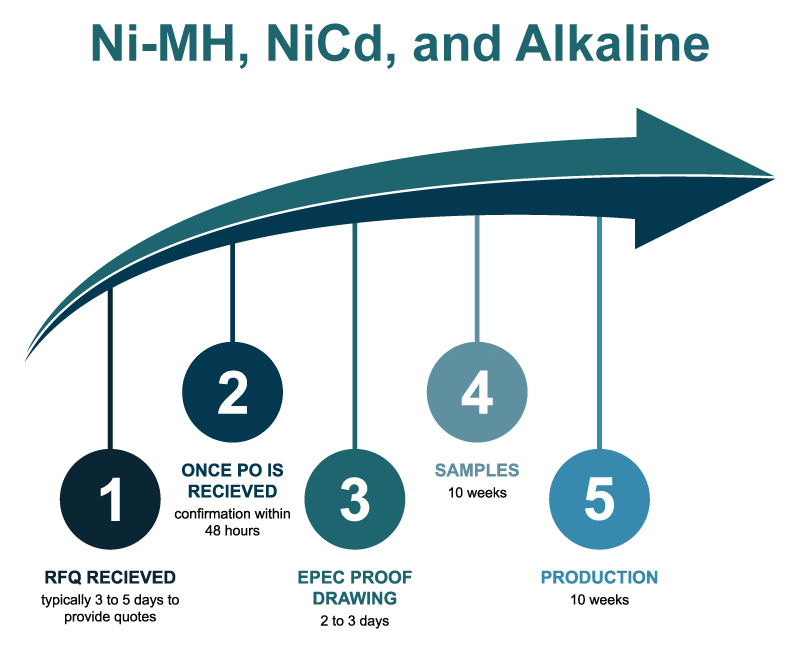
NiMH, NiCD, Alkaline Battery Pack Development Timeline Explained
Standard Lithium Battery Packs
Standard lithium battery packs modify the existing battery management system design and use a soft pack configuration. While more complex than NiMH or NiCd packs, they do not require a fully custom BMS or enclosure design.
Standard Lithium Battery Pack Development Timeline
- RFQ issued; quote typically provided within 3 to 5 days
- PO confirmed within 48 hours
- Sample quantities established during quoting
- Proof drawing created and reviewed within 2 to 3 days
- Customer design review typically completed within 3 to 5 days
- Sample build lead time is typically 10 weeks
- Customer testing and approval timeframe varies widely based on application
- Production lead time is typically 10 weeks following approval
- Design changes trigger a revised proof and updated sample cycle
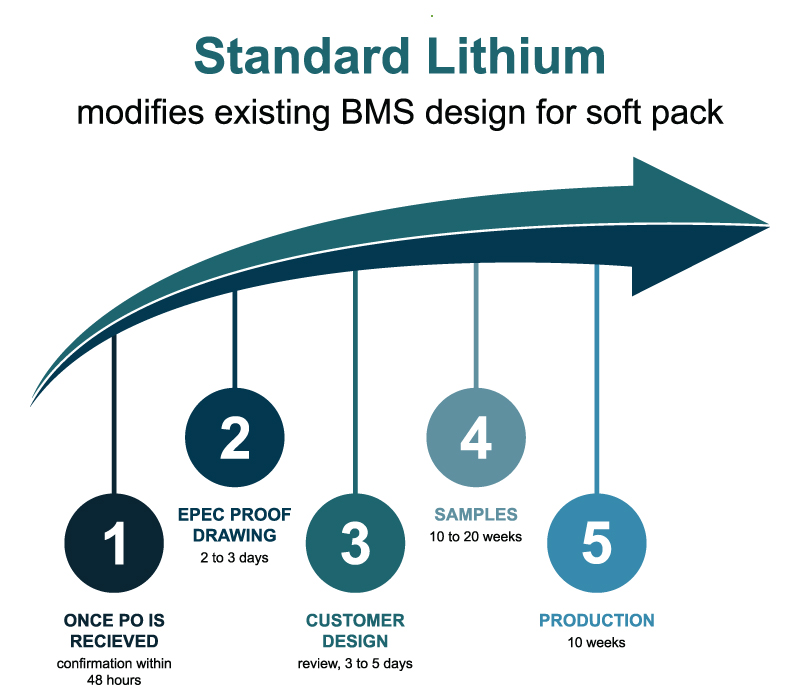
Standard Lithium Battery Pack Development Timeline Explained
Non-Standard Lithium Battery Packs
Non-standard lithium battery packs require full development, including a custom battery management system and enclosure. These projects involve additional engineering phases and longer, more variable timelines.
Non-Standard Lithium Battery Pack Development Timeline
- RFQ received; quote typically provided in 10 to 20 days due to design complexity
- PO confirmed within 48 hours
- Sample quantities defined during quote review
- Proof drawing preparation and approval typically takes 2 to 3 days
- Customer review and revision cycles generally occur within 3 to 5 days
- PCBA and enclosure design require additional collaboration and customer approval
- Sample lead time typically ranges from 10 to 20 weeks, often using 3D-printed enclosures
- Customer testing and approval can take from 1 day to several months
- Production proceeds with a typical 10-week lead time, subject to component availability
- Any required modifications restart the proof and sample approval process
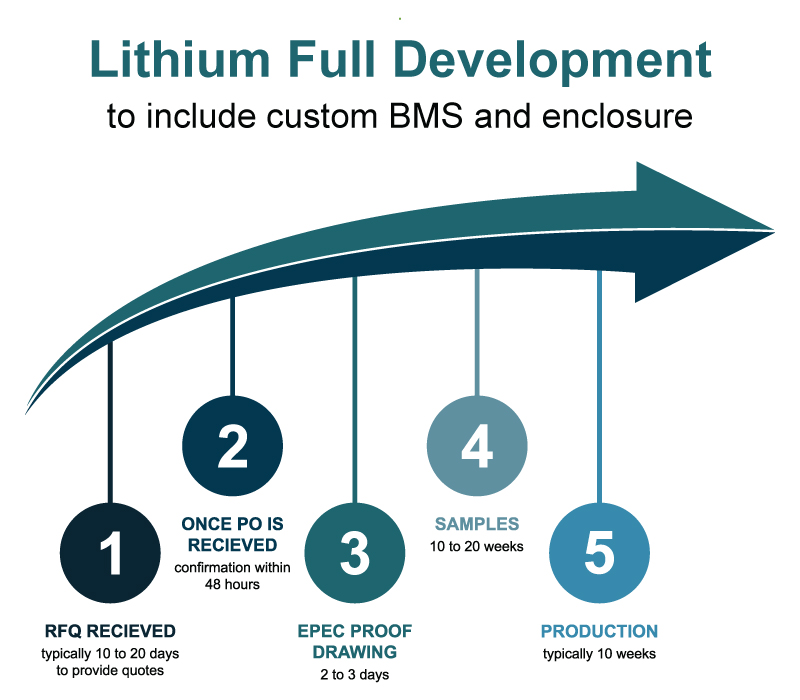
Non-Standard Lithium Battery Pack Development Timeline Explained
DOT /UN38.3 Certification
All lithium battery packs require DOT / UN38.3 certification for production shipping. Certification can only begin after sample approval.
DOT / UN38.3 Certification Process
- Assembly of a 17-unit sample lot, typically 8 to 10 weeks
- Testing by an approved agency, approximately 6 to 8 weeks
- Draft electronic certification provided in 8 to 10 weeks
- Customer or representative review and approval adds approximately 1 additional week
- Typical total certification lead time: 14 to 16 weeks
DOT UN38 3 Certification - Battery Pack Development Timeline Explained
UL2054 Certification
UL2054 certification requires destructive testing and a larger sample quantity.
UL2054 Development and Testing
- Assembly of a 55-unit destructive test sample lot, typically 8 to 10 weeks
- Submission to test agency with full specifications and technical documentation
- Testing duration is approximately 12 to 14 weeks
- Draft certification provided within 12 to 14 weeks
- Final approval adds approximately 1 week
- Typical total lead time: 20 to 24 weeks
UL2054 Certification - Battery Pack Development Timeline Explained
IEC62133–2 Certification
IEC 62133-2 certification also involves destructive testing but with a different sample quantity and timeline.
IEC 62133-2 Development and Testing
- Assembly of a 33-unit destructive test sample lot, typically 8 to 10 weeks
- Deployment to testing agency with supporting technical data
- Testing duration is approximately 8 to 10 weeks
- Draft certification issued within 8 to 10 weeks
- Final review and approval add approximately 1 week
- Typical total lead time: 18 to 20 weeks
IEC 62 33 2 Certification - Battery Pack Development Timeline Explained
Frequently Asked Questions
Quick Links
- What factors most affect a battery pack development timeline?
- Why does every battery pack project start with samples?
- What is the difference between standard and nonstandard lithium battery packs?
- How does customer testing impact the overall schedule?
- When is DOT / UN38.3 certification required?
- Why do UL2054 and IEC 621332 certifications take longer?
- What happens if changes are required after samples are built?
What factors most affect a battery pack development timeline?
The development timeline is influenced by battery chemistry, design complexity, and whether the pack uses a standard or custom battery management system and enclosure. Customer review time and testing requirements can also significantly affect the schedule.
Why does every battery pack project start with samples?
All battery pack projects begin with samples so the customer can test, review, and formally approve the design before production. Sample quantities are defined during the quote process and are required for both functional validation and certification where applicable.
What is the difference between standard and nonstandard lithium battery packs?
Standard lithium battery packs typically modify an existing battery management system and use a soft pack design. Nonstandard lithium battery packs require full development, including a custom BMS and enclosure, which adds engineering effort and extends the timeline.
How does customer testing impact the overall schedule?
Customer testing timelines vary widely, from quick bench-level checks to extended in-system or application testing. This review period can take anywhere from one day to several months and is often the largest variable in the project schedule.
When is DOT / UN38.3 certification required?
All lithium battery packs require DOT / UN38.3 certification for production shipping. Certification can only begin after sample approval and includes additional sample builds and third-party testing.
Why do UL2054 and IEC 621332 certifications take longer?
Both UL2054 and IEC 621332 certifications require destructive testing and larger sample quantities. This results in longer sample build times, extended laboratory testing periods, and longer overall certification timelines.
What happens if changes are required after samples are built?
If changes are needed, the proof drawing must be updated and reapproved before producing revised samples. The development process then follows the same steps and timelines as the original sample phase.
Looking for Help with a Battery Development Project?
Engage Epec early in your custom battery pack project to better align design scope, chemistry, certification needs, and production timelines. Contact us today to get started.
Request A Quote Request Design Support Request More InformationRequest a FREE Quote!
We are here to help you will all your custom battery pack needs.
Get Your Quote Now!Not Ready for a Quote? Request more info or email us your inquiry.Ebook - BMS Design Guide for Custom Battery Packs
 Download Your Copy
...or Download Our Custom Battery Pack Design Guide