



Battery Pack GPIO Options
General Purpose Input/Outputs (GPIO) can be added to almost any custom battery pack and can be used to control any battery subsystem or control end-product functions using a simple two-wire interface, I2C.
At a Glance: Battery Pack GPIO Options
- GPIO functionality adds programmable control and monitoring capabilities to custom battery packs through a simple I2C communication interface.
- A single battery pack can support multiple products by using GPIO to adjust operating parameters and control connected subsystems.
- GPIO options can be customized for functions such as voltage regulation, charger control, status monitoring, and system-level automation.
When to Use GPIO in Your Application
The addition of GPIO can be useful when the end system needs additional logic support that was not originally built into the product, or if the logic supports changes based on different end product SKU levels. Visit this article, Integrating GPIO Options in Your Custom Battery Pack to find out more about using GPIO in your application.
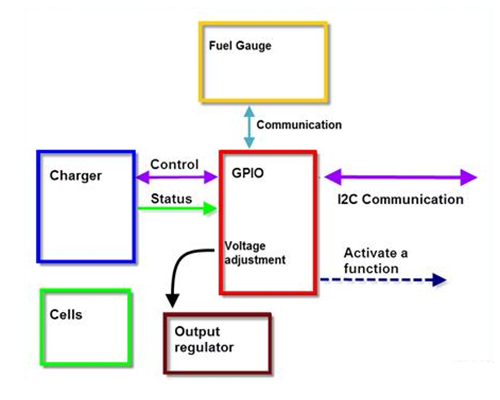 Diagram Depicting How Battery Pack GPIO Options Work
It can serve as the "glue logic" that links various subsystems together as shown in the diagram above. It can be particularly useful when a single battery must support different products with widely varying parameters.
An example of this is when different products require different regulated voltages. The GPIO can be used to adjust the battery's output regulator depending on the software commands from each system, allowing one battery pack to support many different products.
Examples GPIO Options
- Adjust battery charger current.
- Turn LED indicators on and off.
- Automated production BIT.
- Read internal hardware status indicators.
- Voltage monitoring.
- Activate or switchover multiple battery banks.
- Adjust on-board voltage regulators as needed by the fuel gauge or end product.
- Self-destruct to protect IP (for military applications).
Cost Factors of Integrating GPIO Options in Your Battery Pack
Integrating GPIO options to you application does add costs to the final battery pack assembly. When it comes to GPIO, the costs vary widely do to the number of possibilities and features that can be added to tailor the battery pack to very specific needs for your application.
Frequently Asked Questions
Quick Links
- What are GPIO options in a battery pack?
- When should GPIO functionality be added to a battery pack?
- How can GPIO help support multiple products with one battery pack design?
- What functions can GPIO control within a battery-powered system?
- Does adding GPIO increase the cost of a battery pack?
What are GPIO options in a battery pack?
General Purpose Input/Outputs (GPIO) are programmable inputs and outputs that can be integrated into a custom battery pack to provide additional control and communication capabilities. Using a simple I2C interface, GPIO can interact with battery subsystems and external devices to perform specific functions based on system requirements. This allows the battery pack to become more than just a power source by enabling monitoring, automation, and configurable control features. GPIO functionality can be tailored to meet the operational needs of the end product.
When should GPIO functionality be added to a battery pack?
GPIO is often added when a product requires additional logic support that is not built into the host system. It can also be useful when different product models share a common battery platform but require different operating parameters or features. By placing this functionality within the battery pack, designers can simplify system integration and reduce hardware changes between product versions. This flexibility makes GPIO particularly valuable for products with evolving requirements or multiple configurations.
How can GPIO help support multiple products with one battery pack design?
GPIO can be programmed to modify battery pack behavior based on commands received from different devices. For example, the battery can adjust regulator settings, enable specific functions, or respond to product-specific operating requirements. This allows a single battery pack design to support multiple end products without requiring unique battery hardware for each application. The result can be simplified inventory management and greater design flexibility across a product family.
What functions can GPIO control within a battery-powered system?
GPIO can support a wide range of control and monitoring functions depending on the application requirements. Common uses include adjusting battery charger current, controlling LED indicators, monitoring voltage levels, reading internal status signals, and managing multiple battery banks. GPIO may also be used to control voltage regulators or automate production testing procedures. These capabilities allow battery packs to perform application-specific functions that extend beyond basic energy storage and delivery.
Does adding GPIO increase the cost of a battery pack?
Yes, adding GPIO functionality typically increases the overall cost of a battery pack because it requires additional hardware, programming, and system integration. The total cost impact depends on the number of features being implemented and the complexity of the required functionality. Simple monitoring or control functions may require minimal additional resources, while advanced automation and subsystem management may involve more extensive development. The benefits of added flexibility and functionality often justify the investment for applications with specialized requirements.
Looking for a Battery Packs with GPIO Options?
Maximize versatility and control with our custom battery packs featuring GPIO options. Consult our experts to tailor your solution to your application.
Request a Quote Request Design Support Request More InformationRequest a FREE Quote!
We are here to help you will all your custom battery pack needs.
Get Your Quote Now! Not Ready for a Quote? Request more info or email us your inquiry.Ebook - Using Lithium Cells in Custom Battery Packs
 Download Your Copy
...or Download Our Custom Battery Pack Design Guide