



Battery Enclosure Design
Some battery packs are installed inside the product, and only require a shrink-wrap enclosure. In other cases, battery packs are mounted externally and may serve a mechanical function, such as a handle or base for the product. At the same time the case must also protect the cells and the electronics from the harsh operating environments of temperature extremes, water ingress, humidity and vibration in which these batteries work.
Here is everything you need to know, Designing and Managing Custom Battery Pack Enclosures.
At a Glance: Battery Enclosure Design
- Battery enclosures protect cells and electronic circuitry from environmental conditions such as temperature extremes, moisture, vibration, and physical impact.
- Design options range from simple shrink-wrap packaging to complex injection molded housings that provide structural and mechanical functionality.
- Proper enclosure design accounts for thermal management, cell expansion, sealing requirements, and application-specific safety considerations.
Injection Molded Plastic
Enclosures made from injection molded plastics are most commonly used for battery packs. For these enclosed pack designs, two or more plastic parts are molded and then assembled with the pack and accompanied circuitry. They can be sealed using glue, mechanical fasteners (Screws) or ultrasonic welding. The product cost can be reduced by using insert moldings in which the interconnection strips and the terminals are molded into the plastic parts to eliminate both materials and assembly costs.
Get the full story, Innovations in Custom Battery Pack Enclosures and Configurations.
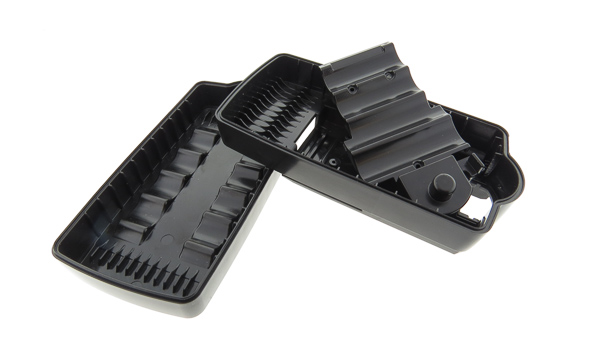 Custom Designed Battery Pack Enclosure Made From Injection Molded Plastic
In some designs, the battery pack can form part of the outer case of the end product and usually requires a mechanical latch to hold the battery in place. This latch as well as the terminals must interface with plastic parts from the device itself so high precision and tight tolerances are essential.
Shrink Wrap or Vacuum Formed Plastic
The simplest and least expensive packaging for small batteries is shrink wrap or vacuum formed plastic. These solutions are only possible if the battery is intended to be completely enclosed by the finished product. In other cases, battery packs are mounted externally and may serve a mechanical function, such as a handle or base for the product. Our extensive experience in designing battery enclosures of all types allow us to enhance the functional design of the product while assuring that the battery passes any shock, vibration and environmental testing required for your application.
Other Considerations
Thermal effects need to be taken into account and, tolerances must allow for potential swelling of the cells. Some Lithium pouch cells may swell as much as 10% or more over the lifetime of the cell. For this reason, enclosures may be designed with vent holes to dissipate generated heat or exhaust vented gases from cells. Multiple vent holes may be used to increase airflow in and out of the pack.
Intrinsically Safe Batteries
Intrinsically safe batteries will not initiate and explosion should the electronic device malfunction while operating in areas that contain explosive gases or high dust concentration. For these applications, specific materials are selected for battery pack enclosure and many times potting material is used in the battery pack enclosure to eliminate any air gaps.
Frequently Asked Questions
Quick Links
- What factors should be considered when designing a battery enclosure?
- Why are injection molded plastic enclosures commonly used for battery packs?
- When is shrink-wrap packaging appropriate for a battery pack?
- How do battery enclosure designs address thermal expansion and heat management?
- What makes an enclosure suitable for intrinsically safe battery applications?
What factors should be considered when designing a battery enclosure?
Battery enclosure design must balance mechanical protection, environmental resistance, safety, and manufacturability. The enclosure needs to protect cells and electronics from shock, vibration, moisture, humidity, and temperature extremes that may be encountered during operation. Designers must also consider how the battery integrates with the end product, especially when the battery pack serves as a structural component such as a handle or base. Material selection, sealing methods, thermal performance, and dimensional tolerances all contribute to the overall effectiveness of the enclosure.
Why are injection molded plastic enclosures commonly used for battery packs?
Injection molded plastic enclosures are widely used because they provide a durable, repeatable, and cost-effective packaging solution for battery packs. Multiple molded components can be assembled around the cells and electronic circuitry using methods such as screws, adhesives, or ultrasonic welding. The molding process also supports complex mechanical features, including integrated terminals, latches, and insert-molded components that can reduce assembly costs. These designs are particularly beneficial when precise alignment and tight tolerances are required for product integration.
When is shrink-wrap packaging appropriate for a battery pack?
Shrink-wrap or vacuum-formed packaging is typically used when the battery pack will be fully enclosed and protected by the final product housing. This approach offers a simple and economical solution for smaller battery assemblies that do not require a dedicated external enclosure. Because the battery relies on the device enclosure for protection, shrink-wrap designs are generally not suitable for applications where the battery is exposed to environmental conditions or physical handling. The packaging method must still support the electrical and mechanical requirements of the application.
How do battery enclosure designs address thermal expansion and heat management?
Battery enclosure designs must account for heat generation and dimensional changes that can occur during battery operation and aging. Some lithium pouch cells can expand over time, requiring adequate internal clearances to prevent excessive mechanical stress. Vent holes may be incorporated into the enclosure to improve airflow, dissipate heat, and provide a path for gases released by cells under abnormal conditions. Careful thermal management helps maintain battery performance, supports safety objectives, and contributes to long-term reliability.
What makes an enclosure suitable for intrinsically safe battery applications?
Intrinsically safe battery applications require enclosure designs that minimize the risk of igniting explosive gases, vapors, or combustible dust. Specially selected enclosure materials may be used to help meet the safety requirements of hazardous operating environments. In many designs, potting materials are added to eliminate air gaps within the enclosure and further reduce ignition risks. These design practices help ensure the battery can operate safely even if a device malfunction occurs in a potentially explosive atmosphere.
Ready to Optimize Your Battery Pack Enclosure?
Enhance your battery pack's protection and functionality with our tailored enclosure solutions.
Request a Quote Request Design Support Request More InformationRequest a FREE Quote!
We are here to help you will all your custom battery pack needs.
Get Your Quote Now! Not Ready for a Quote? Request more info or email us your inquiry.Ebook - Custom Battery Pack Enclosure Design Factors
 Download Your Copy
...or Download Our Custom Battery Pack Design Guide