



Heavy Copper Printed Circuit Boards
Heavy copper printed circuit boards are designed for applications that require high current carrying capacity, improved thermal performance, and increased mechanical strength. Using thicker copper layers, these PCBs support demanding environments where standard copper weights are not sufficient. Early collaboration with manufacturing ensures design feasibility, cost control, and reliable production outcomes.
Heavy copper printed circuit boards use thicker copper traces and planes to support higher current loads and improved durability. These designs are commonly required in power and high-reliability applications where standard copper weights cannot meet performance or environmental demands.
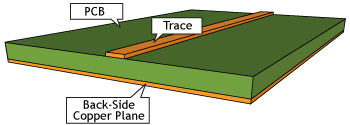
Epec has more than 20 years of experience manufacturing heavy copper PCBs with copper weights up to 6 ounces. Designs are reviewed by engineering teams to ensure manufacturability, quality, and cost efficiency before production begins.
Early design engagement helps identify potential issues and reduces the risk of redesigns that can increase both cost and lead time.
At a Glance: Heavy Copper PCBs
- Heavy copper PCBs use thicker copper layers to support higher current, improved thermal performance, and increased mechanical strength in demanding applications.
- Early collaboration with a PCB manufacturer helps ensure manufacturability, reduces redesign risk, and controls cost and lead time.
- Proven capabilities such as up to 6 oz. copper weight and advanced fabrication processes enable reliable performance in high-power and harsh environment applications.
When to Use Heavy Copper in PCB Design
Heavy copper PCBs are selected when electrical, thermal, or mechanical requirements exceed the capabilities of standard boards.
Typical drivers for heavier copper include:
- High current carrying requirements
- Increased heat dissipation needs
- Improved mechanical strength and durability
- Exposure to harsh environments such as heat, cold, or moisture
Understanding the application early allows engineering teams to align copper weight, layout, and materials with performance expectations.
Key Design and Manufacturing Considerations
Heavy copper PCB fabrication introduces specific challenges that must be addressed during design.
Important considerations include:
- Material availability and longer lead times for heavy copper laminates
- Increased cost of materials compared to standard copper
- Design constraints that may impact manufacturability
- Risk of scrap when tolerances are too tight
Engaging with a PCB manufacturer during the design phase allows for Design for Manufacturability (DFM) feedback. Epec provides engineering support with detailed reviews, including identification of potential problem areas and recommended design adjustments.
This collaborative approach helps reduce production risk and improves first-pass yield.
Working with a PCB Manufacturer Early
Early communication with your PCB manufacturing partner is critical when working with heavy copper designs. Defining the application and operating conditions upfront helps ensure the correct process and materials are selected.
Key information to provide includes:
- End-use application and environment
- Exposure to temperature extremes or moisture
- Electrical performance requirements
- Expected production volumes and lifecycle
Prototyping is commonly used in heavy copper programs to validate performance before scaling to production volumes. Alignment during this phase helps prevent costly redesigns later in the process.
Heavy Copper PCB Capabilities
Epec supports a wide range of heavy copper PCB manufacturing capabilities to meet demanding application requirements.
Specifications
| Parameter | Value | Units |
|---|---|---|
| Maximum Number of Layers | 20 | layers |
| Finished Thickness | 0.020" – 0.275" | inches |
| Minimum Soldermask Clearance | 6 | mils |
| Minimum Solder Dam Width | 5.5 | mils |
| Minimum Drill Bit Hole Size | 0.012" | inches |
| Minimum Hole Size | 0.008" +0.005"/-0.008" | inches |
| Maximum Hole Aspect Ratio | 10:1 | ratio |
| Maximum Copper Weight | 6 | oz. |
| Controlled Impedance | ±10% | percent |
| Minimum Silkscreen Line Width | 8 | mils |
Materials and Finishes
- Laminate options include FR-4 (all Tg ranges), Teflon, and ceramic
- Solder mask and legend inks available in green, blue, red, black, clear, and white
- Surface finishes include Hot Air Solder Leveling (HASL), Immersion Gold (ENIG), and Immersion Silver
- Support for blind and buried vias
These capabilities are supported by a global supply chain designed to meet varying complexity, volume, and lead time requirements.
Applications and Industries
Heavy copper PCBs are widely used in applications that demand high power handling and reliability.
Examples include:
- Welding equipment
- Solar panel manufacturing
- Power supplies
- Automotive systems
- Electrical power distribution
- Power converters
- Military applications
These environments often require enhanced thermal performance and mechanical resilience, making heavy copper an effective solution.
Prototyping and Production Planning
Heavy copper PCB programs often begin with prototyping to validate design performance and manufacturability.
Production planning considerations include:
- Long-term versus one-time build requirements
- Volume scalability from small to large runs
- Inventory and stocking strategies
- Cost optimization through EAU planning and Kanban programs
Providing detailed project information early allows for better alignment between engineering, supply chain, and production teams.
Design Guidelines and Process Alignment
Not all PCB designs are compatible with all manufacturing processes. Aligning layout with manufacturing capabilities improves efficiency and reduces defects.
Following established design guidelines helps:
- Enable standard process settings
- Reduce production time
- Minimize scrap and rework
A well-aligned design ensures consistent quality and predictable production outcomes.
Frequently Asked Questions
Quick Links
- What are the considerations for copper in heavy copper PCBs?
- When should heavy copper PCBs be considered?
- Why is early manufacturer involvement important?
- What challenges are associated with heavy copper PCBs?
- What role does prototyping play?
What are the considerations for copper in heavy copper PCBs?
Copper thickness directly impacts current-carrying capacity, thermal performance, and mechanical strength. Higher copper weights improve durability but also increase material cost and complexity in manufacturing.
When should heavy copper PCBs be considered?
Heavy copper is appropriate when applications require higher current, improved heat dissipation, or enhanced durability beyond standard PCB capabilities.
Why is early manufacturer involvement important?
Early engagement allows for DFM review, identification of potential issues, and alignment of design with manufacturing capabilities. This reduces the risk of redesign and production delays.
What challenges are associated with heavy copper PCBs?
Challenges include higher material costs, longer lead times, and tighter manufacturing tolerances. Improper designs can lead to scrap and reduced yield.
What role does prototyping play?
Prototyping validates performance and manufacturability before full production. It helps identify issues early and ensures the design meets application requirements.
Need a Heavy Copper PCB Solution?
Heavy copper printed circuit boards provide the current-carrying capacity, thermal performance, and durability required for demanding applications. However, they also introduce design and manufacturing complexities that must be addressed early.
Working closely with an experienced PCB manufacturer ensures designs are optimized for manufacturability, cost, and long-term reliability.
Request a Quote Request Design Support Request More Information
Request a FREE Quote!
We are here to help you with all your printed circuit board needs.
Get Your Quote Now! Not Ready for a Quote? Request more info or email us your inquiry.FREE Download: 10 Key Factors Behind HDI PCB Performance
 Download Your Copy
... Or Download Our Circuit Board Design Guide
Free DFM File Check

Submit your PCB data files and we will run a complete DFM check for manufacturability.
Submit Your Data