



PCB Peelable Solder Masks
PCB peelable solder masks protect selected areas of a printed circuit board during surface finishing and assembly processes. Applied by screen-printing and removed after processing, they prevent solder and surface finishes from contaminating contacts, terminals, and plated through holes. This approach replaces manual taping with a faster, cleaner, and more consistent masking method.
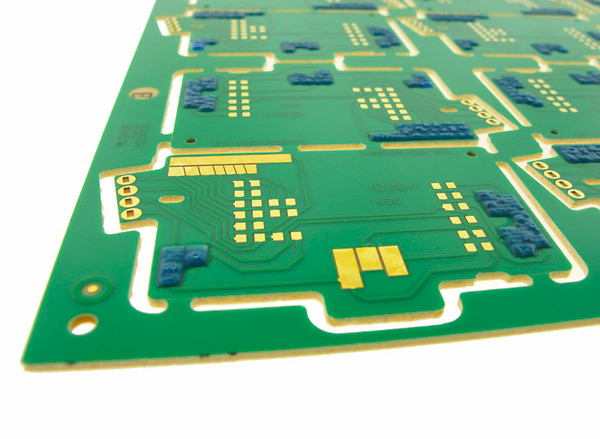 Printed Circuit Board with Peelable Solder Mask
At a Glance: Peelable Solder Mask
- Explains what PCB peelable solder masks are and why they’re used, focusing on temporary protection of contacts, terminals, and plated through holes during surface finishing and assembly.
- Details how peelable solder masks are applied, used, and removed, including screenprinting, protection during wave and reflow soldering, and clean, residuefree removal.
- Highlights key advantages over manual tape masking, such as reduced labor, support for complex board geometries, compatibility with common fluxes, and stable performance at elevated temperatures.
Why Use Peelable Soldermask
Printed circuit boards often require temporary protection of specific areas during surface finishing or assembly to prevent solder from flowing onto contacts, terminals, and plated through holes (PTH). Historically, this protection was achieved using heat-resistant tape applied manually in various shapes and sizes. That approach introduced production delays, higher labor costs, and additional time required to remove tape and clean residues.
Peelable solder masks provide an alternative that supports modern PCB assembly requirements. They are designed to protect sensitive areas during wave soldering, reflow soldering, or during PCB-level surface finishing while improving consistency and reducing manual handling.
General Features and Advantages of the Peelable Solder Mask
Peelable solder masks, also referred to as removable, strippable masks, or blue mask, are applied using a screen-printing process. They act as in-process protection and are removed after the relevant manufacturing steps are complete, typically at the contracted assembly house. The PCB fabricator can apply the mask in nearly any shape or layout, covering one or multiple areas per side in a single operation.
This method allows the PCB supplier to create a single, continuous mask section that can be removed in one pull. Compared to manual taping, peelable masks offer a time- and cost-saving process by eliminating labor-intensive application and modification steps.
Key advantages include:
- Efficient protection of complex PCB geometries using Gerber-defined mask layers
- Consistent coverage across multiple features and surface areas in one screen-printing pass
- Reduced labor and production delays compared to manual heat-resistant tape application
Protection During Assembly and Surface Finishing
Peelable solder masks are well suited for multi-surface finish circuit boards that require selective protection. Surface finishes such as carbon ink, hard gold, or bondable gold often need to be shielded while other finishes, such as ENIG or immersion silver, are applied to the remainder of the PCB.
During assembly, the peelable mask layer can cover larger features, and holes up to 0.120 inches in diameter can be easily protected. The mask prevents solder splash from reaching nearby sensitive areas that are not intended for assembly at that stage. Once removed, those protected areas can be hand assembled or processed mechanically later in the manufacturing flow.
Removal and Compatibility
Removal of the peelable solder mask is straightforward. The mask is lifted at an edge and slowly pulled away from the PCB surface, leaving no residue or particles behind. Unlike traditional tape masking, no additional cleaning steps are required, and solvents such as alcohol are not needed.
The mask material is non-contaminating, non-staining, and non-corrosive, three critical characteristics for successful PCB assembly. It is compatible with rosin, no-clean, and water-soluble flux types, supporting a wide range of assembly processes while maintaining clean, residue-free results.
Material Characteristics
| Parameter | Value | Units |
|---|---|---|
| Maximum hole diameter protected | 0.120 | inches |
| Thermal stability | 550 | °F |
| Thermal stability (metric) | 288 | °C |
| Rogers RO4350 dielectric constant | ~3.5 | — |
| Rogers RO4350 frequency stability range | 0–15 | GHz |
Frequently Asked Questions
Quick Links
- What is a peelable solder mask used for on a PCB?
- How is a peelable solder mask applied?
- How does peelable masking compare to manual tape masking?
- What types of soldering processes are supported?
- Does the peelable mask leave residue after removal?
- Is the peelable solder mask compatible with common flux types?
What is a peelable solder mask used for on a PCB?
A peelable solder mask is used to temporarily protect selected PCB areas during surface finishing or assembly, preventing solder or finishes from contacting sensitive features.
How is a peelable solder mask applied?
It is applied by screen-printing, allowing the PCB fabricator to define protected areas in any shape or layout using a Gerber-based mask layer.
How does peelable masking compare to manual tape masking?
Peelable masking replaces labor-intensive taping with a single mechanical process, reducing production time, labor costs, and cleanup requirements.
What types of soldering processes are supported?
Peelable solder masks can be used during wave soldering, reflow soldering, and PCB-level surface finish protection.
Does the peelable mask leave residue after removal?
No. The mask is removed in one pull and leaves no residue or particles, eliminating the need for additional cleaning.
Is the peelable solder mask compatible with common flux types?
Yes. It is compatible with rosin, no-clean, and water-soluble fluxes used in PCB assembly.
Need a PCB with Peelable Solder Mask?
Peelable solder masks have long surpassed manual masking with heat-resistant tapes such as Kapton. They offer a reliable, time-saving, and cost-saving solution for protecting critical PCB areas during assembly and surface finishing.
The material is RoHS compliant, suitable for use with all surface finishes, phthalate-free, low in toxicity, and environmentally safe. For complex circuit board designs requiring clean protection and efficient processing, peelable solder masks remain an underutilized but effective PCB fabrication option.
Request a Quote Request Design Support Request More InformationRequest a FREE Quote!
We are here to help you with all your printed circuit board needs.
Get Your Quote Now! Not Ready for a Quote? Request more info or email us your inquiry.FREE Download: 10 Key Factors Behind HDI PCB Performance
 Download Your Copy
... Or Download Our Circuit Board Design Guide
Free DFM File Check

Submit your PCB data files and we will run a complete DFM check for manufacturability.
Submit Your Data