



Solving High-Frequency RF Challenges with Hybrid PCB Stack-Ups
Challenge
A customer developing a high-frequency communication system came to Epec with a design that was pushing beyond the limits of traditional PCB manufacturing. Their application required consistent signal performance across frequencies ranging from hundreds of MHz into the multi-GHz range, where even small design or material issues can lead to signal loss, noise, or instability.
From the start, it was clear this was not a standard PCB project. The customer needed to move beyond conventional FR-4 materials, which could not provide the electrical performance required at higher frequencies. At the same time, they were trying to manage cost, size, and manufacturability, all while working within tight project timelines.
Their design also introduced additional complexity through the use of a hybrid stack-up, combining high-frequency laminates with standard materials. While this approach offered a path to balance performance and cost, it created new challenges in fabrication. Differences in material behavior, thermal expansion, and processing requirements made it difficult to maintain tight tolerances and ensure reliable interconnections across the circuit board.
Compounding these issues, the customer was facing uncertainty around sourcing specialized RF materials. Long lead times and limited availability threatened to delay development, putting pressure on both engineering and production schedules.
The customer needed more than just a PCB supplier. They needed a partner who understood the nuances of RF design, could guide material selection, and had the manufacturing capability to bring a complex concept into production without compromising performance.
Solution
Epec worked closely with the customer's engineering team to evaluate the design from both an electrical and manufacturing perspective. Rather than forcing a one-size-fits-all solution, the focus was on finding the right balance between performance, cost, and feasibility.
To meet the electrical requirements, Epec recommended high-frequency laminate materials, including PTFE-based and hydrocarbon ceramic options, which offer lower signal loss and more stable dielectric properties than standard FR-4. These materials were carefully selected based on the customer's target frequency range and overall system requirements.
To keep costs under control, Epec implemented a hybrid stack-up design. High-frequency materials were used only where performance was critical, while standard FR-4 was incorporated in less sensitive areas. This approach allowed the customer to achieve the necessary electrical performance without over-engineering the entire PCB.
Click here to view a larger image.
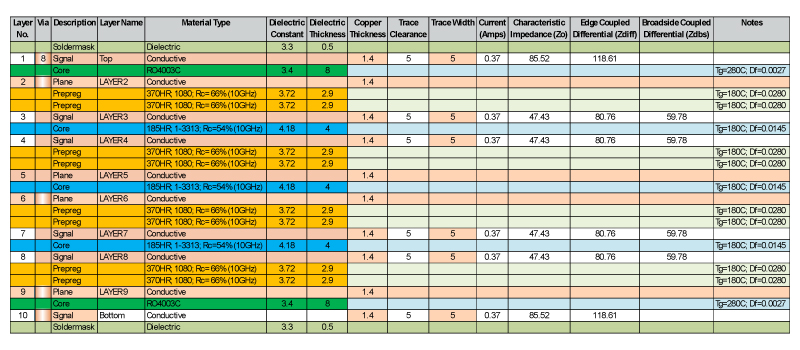 10-Layer hybrid PCB stack-up with Rogers and 370hr material.
10-Layer hybrid PCB stack-up with Rogers and 370hr material.
On the manufacturing side, Epec leveraged its in-house capabilities and material inventory to eliminate common bottlenecks. By stocking key high-frequency laminates and maintaining relationships with major suppliers, Epec was able to reduce lead times and keep the project moving forward.
Advanced processing techniques were also applied to ensure precision and repeatability. Laser direct imaging was used for accurate trace definition and registration, while plasma etching improved plating quality in through-holes. Laser drilling supported fine features and helped avoid material damage, often associated with mechanical methods.
Throughout the process, Epec provided design guidance on impedance control, grounding strategies, and material selection. This collaborative approach helped the customer refine their design while ensuring it could be manufactured reliably at scale.
Result
By the end of the project, the customer had a fully realized RF PCB solution that met both their performance and production goals. The hybrid material approach delivered strong signal integrity across the required frequency range while keeping costs manageable.
Epec's ability to control materials, processes, and design considerations helped eliminate delays and reduce risk throughout development. The final circuit boards were produced with tight tolerances and consistent quality, allowing the customer to move forward with confidence in their system's performance.
Just as important, the customer gained a clearer understanding of how to approach high-frequency PCB design moving forward. The collaboration provided not only a successful product but also a repeatable strategy for balancing electrical performance with manufacturability.
This project highlights what sets Epec apart. When faced with complex RF challenges, the goal is not just to build to print, but to work alongside customers to find practical, engineered solutions that move their projects forward.
Need Help with a PCB Stack-Up?
Ready to take on your next high-frequency PCB challenge? Connect with our engineering team to review your design, explore material options, to keep your project moving forward with confidence.
Request a Quote Request Design Support