



Gerber Layout & Design Recommendations for Flexible Circuits
Epec’s engineering team provides full flex and rigid-flex circuit design services, with a detailed application review performed during the quoting process. Specifications, materials, and construction methods are evaluated to identify and eliminate technical risks before fabrication.
Designs are assessed for reliability, functionality, and compliance with IPC design standards, while also identifying opportunities for cost reduction through improved manufacturability and material efficiency.
At a Glance: Gerber Layout & Design
- Flex circuit reliability starts with stress control: Design practices like radiused corners, staggered traces, fillets, and proper via placement reduce stress concentrators that lead to cracking, delamination, and fatigue.
- Mechanical and electrical performance are tightly linked: Balanced construction, adequate bend radius, and controlled impedance are essential to maintain predictable flex behavior and signal integrity, especially in dynamic or high-speed applications.
- Manufacturability is evaluated early: Epec's engineering review examines materials, stack-up, and construction during the quoting process to identify IPC issues, reliability risks, and cost-saving design improvements.
Radiused Corners Within Flex Bend Areas
Radiused corners are critical in flex bend areas to minimize mechanical stress. Sharp corners create stress concentrators that can lead to cracking or tearing over time, especially in applications involving repeated bending.
Using smooth, rounded corners distributes stress more evenly across the copper and dielectric layers. This improves durability, reduces the risk of conductor fracture, and extends the operational life of the flex circuit.
 Preferred
 Acceptable
 Not Allowed
Staggered Layer-to-Layer Trace Positioning
Staggering trace positions between layers helps eliminate the “I-beam” effect that occurs when traces are aligned directly on top of one another. When traces are vertically stacked, stiffness increases locally, creating weak points that reduce flexibility.
By offsetting traces across layers, mechanical stress is better balanced during bending. This improves overall flexibility and reduces the risk of delamination or cracking in multi-layer flex constructions.
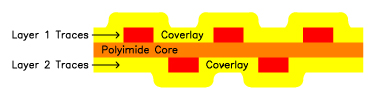 Preferred
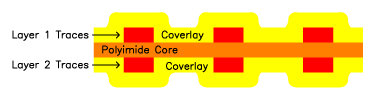 Not Recommended
Fillets and Teardrops
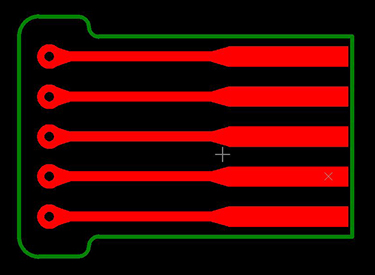
Properly designed fillets and teardrops reduce stress concentrations at critical junctions, improving flex circuit reliability. Sharp angles at trace-to-pad or trace-to-via transitions are prone to cracking under mechanical strain.
Rounded fillets and teardrop geometries create smoother transitions for both copper and plating, helping distribute stress more evenly and reducing the likelihood of fatigue-related failures.
Vias Within Bend Areas
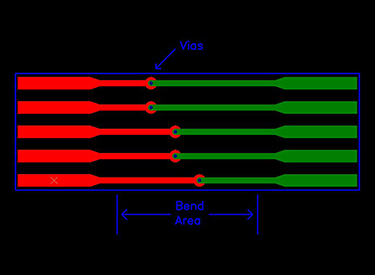
Placing vias in flex bend areas is not recommended. Vias act as localized stress concentrators and are particularly susceptible to mechanical failure when subjected to bending.
During flexing, vias within bend areas may experience cracking, plating fractures, or complete electrical failure. Whenever possible, vias should be located outside dynamic bend regions to reduce risk.
Stiffener and Coverlay Terminations
Improper stiffener and coverlay terminations can introduce significant stress concentrations into a flexible circuit. Poorly terminated materials create abrupt stiffness changes that amplify strain during bending.
Well-controlled terminations allow stress to transition gradually between rigid and flexible regions, improving mechanical reliability. Careful consideration of polyimide coverlay behavior is especially important in flex circuit designs.
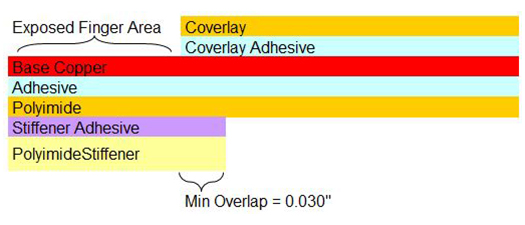 Required
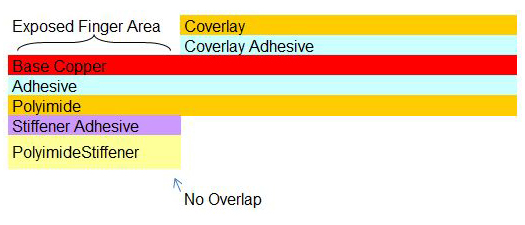 Not Allowed
Additional Design Considerations
Balanced Construction
Balanced construction is fundamental to long-term reliability and manufacturability in flex and rigid-flex circuits. A balanced stack-up is symmetrical around the neutral axis, with evenly matched copper distribution, dielectric thickness, and material types.
Unbalanced designs can accumulate internal stress during lamination and thermal cycling, leading to warpage, twisting, and dimensional instability. In flex circuits, imbalance also shifts the neutral bend axis, increasing strain on outer layers. Proper balance improves registration, reduces delamination risk, and ensures predictable mechanical behavior during use.
Controlled Impedance
Controlled impedance is essential for flex and rigid-flex circuits carrying high-speed or high-frequency signals. Achieving target impedance is more complex in flexible materials due to thinner dielectrics and dynamic mechanical conditions.
Impedance control depends on precise management of trace geometry, copper thickness, dielectric constant, and spacing to reference planes. Variations can cause signal reflections, loss, or electromagnetic interference. Special attention is required at rigid-to-flex transitions, where impedance discontinuities commonly occur. Effective impedance control relies on careful stack-up design, simulation, and close collaboration with the fabricator.
Adequate Bend Radius
The bend radius directly affects the mechanical strain applied to copper and dielectric layers during flexing. Tight bend radii increase tensile stress on outer layers, which can result in cracked conductors, fractured plating, or material fatigue.
Minimum bend radius is typically defined as a multiple of total circuit thickness and increases with layer count and copper weight. Dynamic flex applications, which bend repeatedly, require larger bend radii than static flex PCB designs. Designing for an appropriate bend radius supports long cycle life and field reliability.
Via Protection
Vias are inherently vulnerable stress points in flex circuits, especially in areas exposed to bending. Without proper design, vias may crack, separate, or lose electrical continuity over time.
Stress-reduction techniques include the use of teardrop pads, reinforcing surrounding material, and keeping vias out of dynamic bend regions. In more demanding applications, via capping or filled vias may be used to enhance mechanical strength and durability.
Use of Eccobond
Eccobond and similar epoxy-based adhesives are used in flex and rigid-flex circuits when additional mechanical reinforcement or environmental protection is required. Common application areas include component termination zones, stiffener interfaces, and rigid-to-flex transitions.
Its use must be carefully controlled. Eccobond introduces additional processing steps, increases local thickness and stiffness, and can affect reworkability. For these reasons, it is typically applied only in localized high-stress areas where the added strength justifies the impact on flexibility and cost.
Best Practices Summary for Flex Circuit Design
Key design practices that improve flex circuit reliability include:
- Using radiused corners to reduce mechanical stress
- Staggering traces between layers to avoid stiffness concentration
- Applying fillets and teardrops at trace transitions
- Maintaining balanced layer construction
- Designing for controlled impedance where required
- Selecting an adequate bend radius for static or dynamic use
- Protecting vias through geometry, placement, and reinforcement
Adhering to these practices helps ensure flex circuits withstand mechanical stresses throughout assembly and end use.
Frequently Asked Questions
Quick Links
- Why are radiused corners important in flex circuit design?
- What is the benefit of staggered trace positioning?
- How do fillets improve flex circuit performance?
- Why is balanced construction crucial in flex circuits?
- What is controlled impedance, and why is it important?
- How is the minimum bend radius determined?
- What measures can protect vias in flex circuits?
Why are radiused corners important in flex circuit design?
Sharp corners concentrate mechanical stress and create natural failure points, especially in areas subject to bending. Radiused corners distribute that stress more evenly across the material, reducing the likelihood of cracking in both the copper traces and the dielectric. This is particularly important in dynamic flex applications where repeated motion amplifies stress over time.
What is the benefit of staggered trace positioning?
Staggering traces across layers prevents stacking conductors directly on top of each other, which would create localized stiffness and uneven stress distribution. By offsetting traces, the circuit maintains more uniform flexibility and reduces the risk of delamination or cracking along a single stress line. This approach helps preserve both mechanical integrity and electrical reliability.
How do fillets improve flex circuit performance?
Fillets create smooth transitions where traces connect to pads or change direction. Without fillets, sharp junctions become stress concentration points that are prone to cracking under flexing. By smoothing these transitions, fillets reduce mechanical strain and improve the durability of the copper features, particularly in high flex or vibration environments.
Why is balanced construction crucial in flex circuits?
Balanced construction ensures that the circuit remains dimensionally stable during fabrication and use. An unbalanced design can warp, twist, or shift during lamination and thermal cycling, leading to registration issues and mechanical stress. In flex applications, imbalance also affects how the circuit bends, increasing the likelihood of failure in critical areas.
What is controlled impedance, and why is it important?
Controlled impedance ensures that electrical signals travel through the circuit with minimal reflection and loss. This is critical for high-speed digital and RF applications where signal integrity directly impacts performance. Poor impedance control leads to noise, distortion, and potential system failure, especially in tightly packed, high-performance designs.
How is the minimum bend radius determined?
The minimum bend radius is determined by the total thickness of the circuit, the number of layers, the copper weight, and whether the application is static or dynamic. Thicker circuits and higher layer counts require larger bend radii to limit strain. Following established design guidelines ensures that the circuit can flex without damaging the conductive or dielectric materials.
What measures can protect vias in flex circuits?
Protecting vias involves both design and placement strategies. Teardrop pads help distribute stress while keeping vias out of dynamic bend areas, which reduces mechanical loading. Reinforcing the surrounding material or using advanced via structures, such as filled or capped vias, can further improve durability. These measures help maintain electrical continuity and prevent failures caused by repeated flexing.
Looking for Design Help?
Epec's engineering team works closely with customers to improve flex circuit reliability, manufacturability, and cost efficiency. Contact us to discuss your design requirements and request a custom quote.
Request a Quote Request Design Support Request More InformationRequest a FREE Quote!
We are here to help you with all your rigid-flex PCB needs.
Get Your Quote Now! Not Ready for a Quote? Request more info or email us your inquiry.Ebook - Designing Flex Circuits for Dynamic Bending Applications
 Download Your Copy
... Or Download Our Flex & Rigid-Flex Circuits Design Guide
Free DFM File Check

Submit your flex or rigid-flex PCB data files and we will run a complete DFM check for manufacturability.
Submit Your Data