

Wave Soldering Defects


Sunken Joints

Sunken joints on the base of the board are most commonly caused by outgassing from the printed board. Like small voics in the solder fillets (referred to as pin holes or blow holes), they are seen as another process indicator. If the copper plating thickness remains a minimum of 25µm in the barrel of the hole, moisture will not outgass through the copper during soldering.
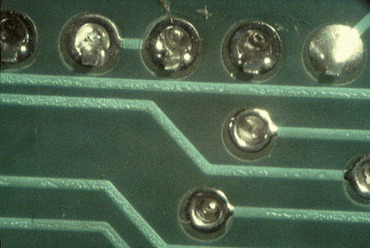

Figure 1: Sunken solder joints caused by outgassing.

Figure 1: Sunken solder joints caused by outgassing.

On the top side of the board, sunken or depressed joints can occur for the following reasons:

  • Hole to lead ratio where the solder literally sinks due to its own weight.
  • Some form of contamination or obstruction does not allow the solder to rise in the hole.
  • Poor pre heat or fluxing does not allow the solder to fully wet the plated through hole.

In Figure 2, the insulation on the body of the part was also found on the top of the leads, which made joint formation difficult to achieve.
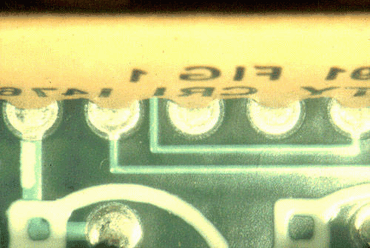

Figure 2: The component's insulation interfered with joint formation.

Figure 2: The component's insulation interfered with joint formation.

The most common cause of sunken joints is the hole-to-lead ratio. If the hole is large in comparison to the lead diameter, the solder literally drops in or out of the hole.

In cases where the solder has not reflowed directly on the top side of the board, sunken joints on the tops side of the board can be caused by incorrect pre-heat or poor fluxing. This would not be the case in the example shown in Figure 3 as the tin/lead has either reflowed on to the top side or caused the existing solder coating to reflow.

Sunken joints on the base of the board may be caused by outgassing. If the soldering process is functioning correctly when the hole outgasses the solder tends to shrink back into the hole to fill the void.
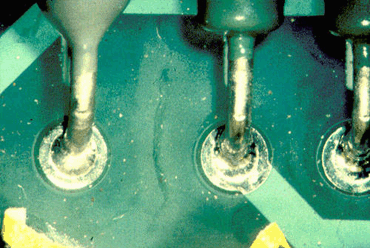

Figure 3: Adhesive contamination on the pad surface caused this solder skip.

Figure 3: Adhesive contamination on the pad surface caused this solder skip.

A simple test to prove if the PCB is causing the problem is outlined here:

The test is used to evaluate printed circuit boards with plated through holes for outgassing. It indicates the incidence of thin plating or voids present in through hole connections. It may be used at goods receipt, during production or on final assemblies to determine the cause of voids in solder fillets. Provided that care is taken during testing the boards may be used in production after test without any detriment to the visual appearance or the reliability of the final product.

Test Equipment

  • Sample printed circuit boards for evaluation
  • Canada Bolson oil or a suitable alternative that is optically clear for visual inspection and can be easily removed after test
  • Hypodermic syringe for application of oil in each hole
  • Blotting paper for removing excess oil
  • Microscope with top and underside lighting. Alternatively, a suitable magnification aid of between 5 to 25x magnification and a light box
  • Soldering iron with temperature control

Test Method

  • A sample board or part of a board is selected for examination. Using a hypodermic syringe, fill each of the holes for examination with optically clear oil. For effective examination, it is necessary for the oil to form a concave meniscus on the surface of the hole. The concave form allows an optical view of the complete plated through hole. The easy method of forming a concave meniscus on the surface and removing excess oil is to use blotting paper. In the case of any air entrapment being present in the hole, further oil is applied until a clear view of the complete internal surface is obtained.
  • The sample board is mounted over a light source; this allows illumination of the plating through the hole. A simple light box or illuminated bottom stage on a microscope may provide suitable lighting. A suitable optical viewing aid will be required to examine the hole during test. For general examination, 5X magnification will allow viewing of bubble formation; for a more detailed examination of the through hole, 25X magnification should be used.
  • Next, reflow the solder in the plated through holes. This also locally heats the surrounding board area. The easiest way to do this is to apply a fine-tipped soldering iron to the pad area on the board or to a track connecting to the pad area. The tip temperature can be varied, but 500°F is normally satisfactory. The hole should be examined simultaneously during application of the soldering iron.
  • Seconds after the complete reflow of the tin lead plating in the through hole, bubbles will be seen emanating from any thin or porous area in the through plating. Outgassing is seen as a constant stream of bubbles, which indicates pin holes, cracks, voids or thin plating. Generally if outgassing is seen, it will continue for a considerable time; in most cases it will continue until the heat source is removed. This may continue for 1-2 minutes; in these cases the heat may cause discoloration of the board material. Generally, assessment can be made within 30 seconds of application of heat to the circuit.
  • After testing, the board may be cleaned in a suitable solvent to remove the oil used during the test procedure. The test allows fast and effective examination of the surface of the copper or tin/lead plating. The test may be used on through holes with non tin/lead surfaces; in the cases of other organic coatings, any bubbling due to the coatings will cease within a few seconds. The test also provides the opportunity to record the results both on video or film for future discussion.