



Types of Coaxial Cables
Since the advent of the RG numbering system, manufacturers have continually advanced cable technology through research and development. This has been necessary to keep pace with emerging applications and includes improvements to both materials and manufacturing processes. An array of coax with expanded operational capabilities has emerged, allowing additional system design capabilities. More information available here, Coaxial Cable and Connector Options for Low-Cost RF Cables.
At a Glance: Coaxial Cable Types
- Wide selection of flexible, semi-rigid, and formable coaxial cable options designed to balance signal performance, shielding effectiveness, flexibility, and installation requirements.
- Available with a variety of dielectric materials, conductor constructions, shielding configurations, and attenuation characteristics to support diverse RF and microwave applications.
- Engineering support to help select the optimal coaxial cable type based on frequency, insertion loss, routing complexity, shielding requirements, and environmental conditions.
Coax Type and Electrical Specifications
| Coax Description | Outside Diameter (in) | Dielectric Material | Center Conductor Material | Shield Material | dB/100 ft | |
|---|---|---|---|---|---|---|
| @400 MHz | @10 GHz | |||||
| RG-58C | 0.195 | PE | Ag/Cu | Ag/Cu Braid | 14 | |
| RG-119 | 0.465 | ST | Ag/Cu | Ag/Cu Braid | 3.8 | |
| RG-120 | 0.523 | ST | Ag/Cu | Ag/Cu Braid | 3.8 | |
| RG-122 | 0.16 | PE | Ag/Cu | Ag/Cu Braid | 18 | |
| RG-142/A/B | 0.195 | ST | Ag/Cu | Ag/Cu Braid | 9 | |
| RG-177 | 0.895 | PE | Ag/Cu | Ag/Cu Braid | 2.8 | |
| RG-178/A/B | 0.072 | PTFE | Ag/Cu | Ag/Cu Braid | 29 | |
| RG-211/A | 0.73 | ST | Ag/Cu | Ag/Cu Braid | 2.3 | |
| RG-212 | 0.332 | PE | Ag/Cu | Ag/Cu Braid | 6.5 | |
| RG-213 | 0.405 | PE | Ag/Cu | Ag/Cu Braid | 5.5 | |
| RG-214 | 0.425 | PE | Ag/Cu | Ag/Cu Double Braid | 5.5 | |
| RG-215 | 0.463 | PE | Ag/Cu | Ag/Cu Braid | 5.5 | |
| RG-217 | 0.545 | PE | Ag/Cu | Ag/Cu Braid | 4.3 | |
| RG-218 | 0.87 | PE | Ag/Cu | Ag/Cu Braid | 2.5 | |
| RG-219 | 0.928 | PE | Ag/Cu | Ag/Cu Braid | 2.5 | |
| RG-223 | 0.211 | PE | Ag/Cu | Ag/Cu Double Braid | 8.8 | |
| RG-303 | 0.17 | PTFE | Ag/Cu | Ag/Cu Braid | 9 | |
| RG-304 | 0.28 | PTFE | Ag/Cu | Ag/Cu Braid | 6 | |
| RG-316 | 0.102 | PTFE | Ag/Cu | Ag/Cu Braid | 20 | |
| RG-393 | 0.39 | PTFE | Ag/Cu | Ag/Cu Braid | 5 | |
| RG-400 | 0.195 | PTFE | Ag/Cu | Ag/Cu Braid | 9.6 | |
| RG-401 Semi-Rigid | 0.25 | PTFE | Ag/Cu | Cu Solid Jacket | 33 | |
| RG-402 Formable | 0.141 | PTFE | Ag/Cu | Sn/Cu Braid | 50 | |
| RG-402 Semi-Rigid | 0.141 | PTFE | Ag/Cu | Cu Solid Jacket | 41 | |
| RG-403 | 0.116 | PTFE | Ag/Cu/ | Ag/Cu Braid | 29 | |
| RG-405 Formable | 0.086 | PTFE | Ag/Cu | Sn/Cu Braid | 82 | |
| RG-405 Semi-Rigid | 0.086 | PTFE | Ag/Cu | Cu Solid Jacket | 65 | |
Diagram of Coaxial Cables Types
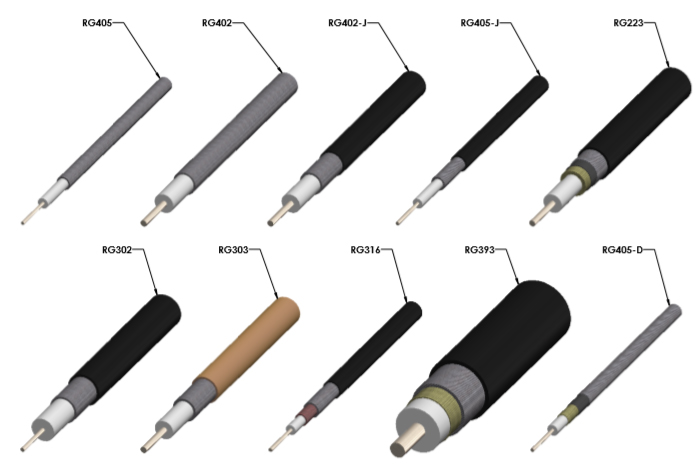
Flexible Coax
Having originally set the standard of performance, flex has been the go-to for military and aerospace applications. This type of coax yields lower electrical performance when compared to semi-rigid and formable cables but offers lower cost. A flex cable utilizes either a stranded center conductor where repeated flexing is required or a solid conductor when lower loss is necessary.
Generally, a silver-plated copper shielding braid over the insulator provides a high level of flexibility but shielding is not continuous due to the air gaps between the stranded braid. The shielding can be further degraded when flexing of the assembly occurs, increasing the size of the air gaps. This can be overcome by specifying a second or third layer of shielding, but flexibility is then sacrificed.
Semi-Rigid Coax
Utilizing a solid outer shield made of either copper or aluminum, the semi-rigid cable provides superior shielding compared to a woven braid. This is especially apparent when higher operational frequencies are required. While offering higher shielding performance, this coax is also less flexible and therefore requires fixturing to achieve complex routing bends.
Formable Coax
Constructed with a tin-filled copper outer conductor braid, the formable cable has similar performance characteristics of semi-rigid but offers the flexibility to be formed and reformed without degradation to the coax. Being hand formable, a cost savings is realized due to a lack of need for fixturing where routing bends are required.
Frequently Asked Questions
Quick Links
- What are the primary types of coaxial cables?
- When should flexible coaxial cable be used?
- What are the advantages of semi-rigid coaxial cable?
- How does formable coax compare to semi-rigid coax?
- How do engineers select the right coaxial cable for an RF application?
What are the primary types of coaxial cables?
The three primary coaxial cable categories are flexible coax, semi-rigid coax, and formable coax. Flexible coax is designed for applications requiring movement, easier routing, and lower cost. Semi-rigid coax provides superior shielding and high-frequency performance through a solid outer conductor but requires bending tools or fixtures for installation. Formable coax offers a middle ground by combining many of the electrical benefits of semi-rigid cable with the ability to be hand-formed and adjusted during installation.
When should flexible coaxial cable be used?
Flexible coax is commonly selected when cost, ease of installation, and repeated movement are important considerations. It is widely used in military, aerospace, commercial, and industrial applications where routing flexibility is needed. Flexible designs typically utilize stranded or solid center conductors and braided shielding, making them well suited for cable assemblies that may need to flex during operation or maintenance.
What are the advantages of semi-rigid coaxial cable?
Semi-rigid coaxial cable uses a solid copper or aluminum outer conductor instead of a braided shield. This construction provides excellent shielding effectiveness and improved performance at higher frequencies by minimizing signal leakage and interference. Semi-rigid cables are often chosen for microwave, aerospace, defense, and high-performance RF systems where signal integrity is critical and cable routing remains relatively fixed after installation.
How does formable coax compare to semi-rigid coax?
Formable coax provides electrical performance characteristics that are similar to semi-rigid cable while offering greater installation flexibility. Its tin-filled copper outer braid allows engineers and technicians to bend and reshape the cable without significantly affecting performance. Because specialized forming fixtures are typically unnecessary, formable coax can reduce assembly complexity and lower installation costs in applications requiring custom routing paths.
How do engineers select the right coaxial cable for an RF application?
Cable selection depends on several factors, including operating frequency, insertion loss requirements, shielding effectiveness, mechanical flexibility, environmental conditions, power handling requirements, and available installation space. Engineers must often balance electrical performance against routing and cost considerations. For example, a high-frequency microwave application may benefit from semi-rigid cable, while equipment requiring frequent movement may be better served by a flexible or formable coax solution that can withstand handling and dynamic operation.
Request a FREE Quote!
We are here to help create a cable assembly that will exceed your requirements.
Get Your Quote Now! Not Ready for a Quote? Request more info or email us your inquiry.